

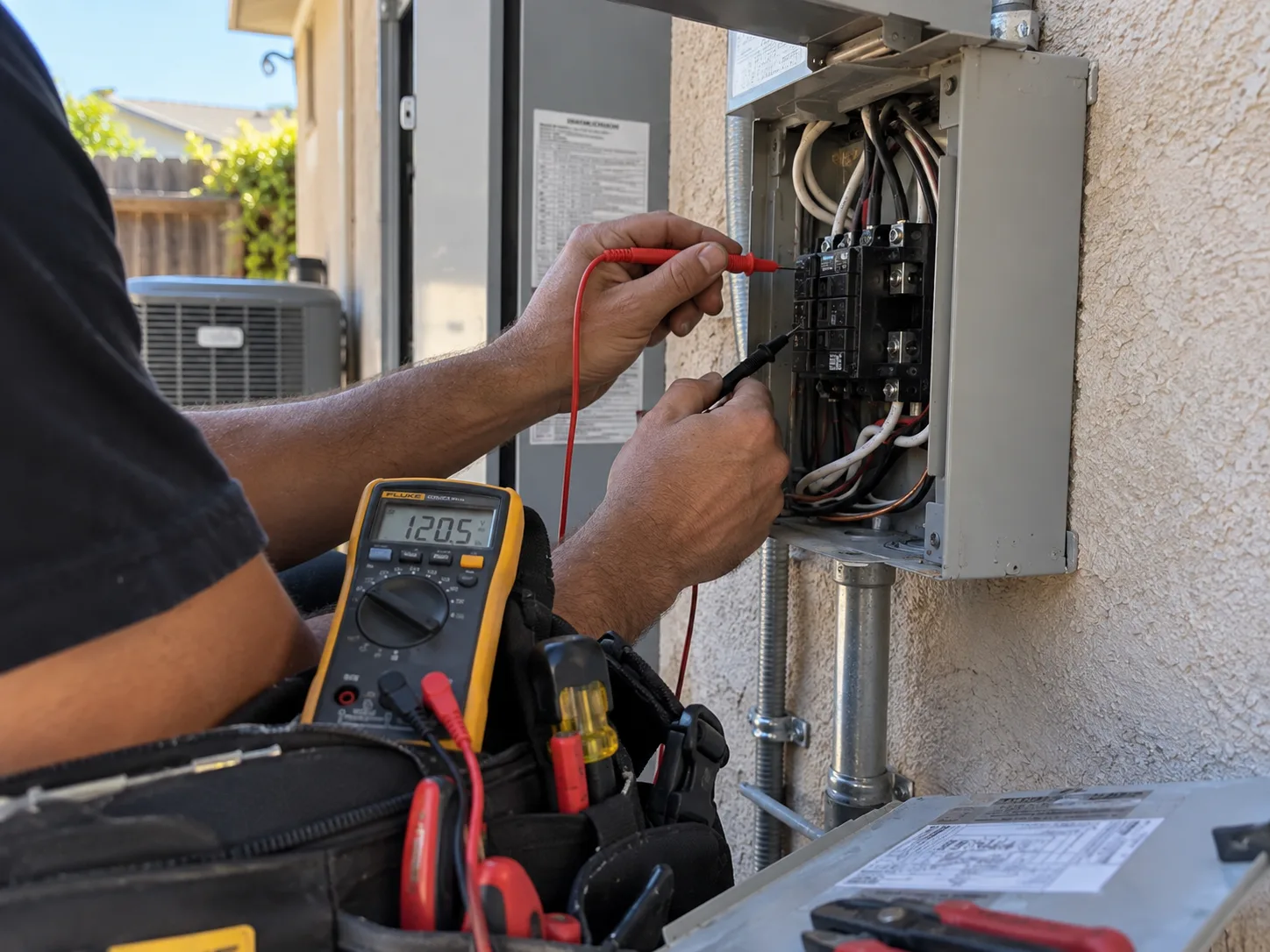
Start With the Symptom. We’ll Help Find the Electrical Problem.
Dead outlets, tripping breakers and flickering lights can have more than one cause.
You don’t need to diagnose the problem yourself. Tell J.I.C. Electric what you’re seeing, hearing or experiencing and we’ll start with the electrical system.
What’s the Electrical System Doing?
Pick the closest symptom. You get a plain explanation of what it usually means, and the symptom carries into the request form below.
A breaker keeps tripping
A breaker doing its job is information. The question is whether the circuit is overloaded, something on it has failed, or there is a fault in the wiring.
- ✓Circuit load measured rather than guessed
- ✓Devices and connections on the circuit checked
- ✓Fault located before anything is replaced
Tell us which breaker and what is on that circuit.
An outlet stopped working
Often the outlet is fine and something upstream is not — a tripped GFCI, a failed device in the middle of the run, or a loose connection.
- ✓Circuit traced from the panel forward
- ✓Upstream devices and splices checked
- ✓Failed devices replaced, not just re-tested
Note whether other outlets nearby are also dead.
Lights flicker or dim
This can start at the fixture, the dimmer, a connection, the circuit or the service. Where it happens narrows it quickly.
- ✓Whether it is one fixture or the whole house
- ✓Dimmer and lamp compatibility checked
- ✓Connections and neutrals inspected
Tell us if it happens when appliances start up.
Partial power loss
When half a property goes dark, the cause is usually upstream of the individual circuits.
- ✓Service and panel checked first
- ✓Feeders and connections inspected
- ✓Findings documented in plain language
Say which areas are affected and when it started.
A switch does not work
Switches fail, but so do the connections behind them and the devices they control.
- ✓Switch and box connections checked
- ✓Controlled fixture or device tested
- ✓Three-way and multi-switch runs traced
Mention if it worked intermittently before failing.
A GFCI keeps tripping
A GFCI tripping repeatedly usually means it is detecting something, or the device itself has aged out.
- ✓Downstream circuit checked for moisture and faults
- ✓Device age and condition evaluated
- ✓Correct protection type confirmed for the location
Note whether it is indoors, outdoors or in a bathroom.
Something buzzes or hums
Noise from a device, fixture or panel is worth looking at rather than living with.
- ✓Source located — device, fixture, dimmer or equipment
- ✓Connections and terminations inspected
- ✓Damaged components replaced
Do not keep using a buzzing device in the meantime.
A device or cover feels warm
Warmth at an outlet, switch or plate is a symptom that should be checked promptly.
- ✓Load and connections at the device checked
- ✓Evidence of overheating documented
- ✓Damaged devices and terminations replaced
Stop using the device until it has been checked.
Electrical equipment looks damaged
Scorching, melted plastic, corrosion or physical damage changes the priority of the visit.
- ✓Condition assessed before anything is re-energized
- ✓Damaged equipment replaced
- ✓Cause identified so it does not repeat
Send a photo with the request if it is safe to take one.
Something else
Electrical problems do not always fit a list. Describe what you are noticing — including the intermittent ones.
- ✓No diagnosis needed from you
- ✓Testing before replacing
- ✓What was found and fixed written down for you
When it started and what makes it happen helps most.
Diagnosis First, Then the Repair
The point of a troubleshooting visit is to find the actual cause before anything gets replaced.
Electrical Troubleshooting
Diagnosis of electrical problems before deciding what needs to be replaced or repaired.
Electrical Repair Services
Repairs to circuits, devices, wiring and electrical equipment within J.I.C.’s scope.
Circuit Breaker & Fuse Box Problems
Troubleshooting circuits that trip, fail or behave unexpectedly.
Dead Outlets
Diagnosis of outlets or groups of receptacles that lose power.
Flickering or Dimming Lights
Identify whether the issue starts at a fixture, device, circuit, connection or elsewhere in the system.
GFCI Problems
Troubleshooting and replacement of GFCI-protected receptacles and circuits.
Outlets & Switches
Repair, replacement or installation of damaged or outdated electrical devices.
Wiring Repairs
Correction of damaged, loose or otherwise problematic wiring where accessible and appropriate.
Partial Power Loss
Troubleshoot situations where only part of a property loses power.
Smoke & CO Detector Electrical
Installation or replacement of compatible hardwired devices when within scope.
Surge Protection
Electrical surge-protection solutions where appropriate for the property.
Safety Review & Corrections
Evaluate known electrical concerns — overheating devices, improper splices, missing protection, unsafe past work — and perform the corrections required to bring them up to code.
What a Troubleshooting Visit Looks Like
Diagnosis is a process of elimination, and it goes faster when the symptom is described accurately.
- 1Your part
What you describe
Symptom, location, when it started and what makes it happen. That narrows the search before anyone opens a panel.
- 2On site
Test, do not assume
Circuits are measured and traced. Parts do not get replaced on a hunch.
- 3Diagnosis
Find the cause
The failed device, connection, splice or damaged conductor is located rather than worked around.
- 4Your decision
Repair options
What it takes to fix it properly, and what is optional, explained in plain language before work continues.
- 5Closeout
Written findings
What was wrong, what was replaced and anything worth watching, documented for you.
Intermittent problems are the real test
Anything obvious gets found on the first visit. The value of approximately 20 years in the field shows up on intermittent faults — the ones that only appear when the dryer runs, or after it rains.
Repair work is rarely photogenic, but these two projects started the same way most repairs do — tracing what was already in the walls before adding anything new.

1920s bungalow whole-home rewire
- Property / project type
- 1920s Spanish bungalow
- Electrical challenge
- Original cloth-insulated branch wiring plus decades of added-on circuits
- Scope of work
- Whole-home rewire, service and main panel upgrade, recessed lighting on dimmers, GFCI and AFCI protection to current code, exterior receptacles and lighting
- Result
- Plaster opened and patched only where required; labeled panel at final

Whole-home ranch renovation
- Property / project type
- 1960s single-story ranch on a canyon lot
- Electrical challenge
- Original branch wiring and undersized distribution throughout
- Scope of work
- Panel replacement, complete rewire, recessed LED on dimmers, kitchen appliance circuits, fan-rated boxes, deck lighting, smoke and CO coverage
- Result
- Labeled panel, tested circuits, passed final inspection
Repair Questions
Do I need to know what is wrong before calling?+
No. Describe the symptom — what is happening, where, and when it started. Diagnosis is part of the work.
Do you offer 24/7 emergency service?+
Regular hours are Monday to Friday, 7:00am to 5:00pm. Urgent electrical problems are worked in as the schedule allows — call and say it is urgent. If there is smoke, fire, sparking or any immediate danger, leave the area and contact emergency services first.
Can I send photos of the problem?+
Yes, if it is safe to take them. A photo of the panel, the device or the damage often shortens the first conversation.
Will you have to open up my walls?+
Only where it is necessary to reach the problem. Accessible routes are used first, and anything that has to be opened is discussed before it happens.
Do you handle small repairs as well as large projects?+
Yes. Single-device and single-circuit work is normal, alongside larger project work.
What if the problem turns out to be the panel or the service?+
Then you get told that, with the reasoning and the options. Panel and service work is handled in-house.
Need Help With an Electrical Problem?
Short form on purpose. The symptom, where it is, and when it started is enough to get moving.
- ✓No diagnosis required from you
- ✓Photos welcome if it is safe to take them
- ✓Findings documented in plain language